
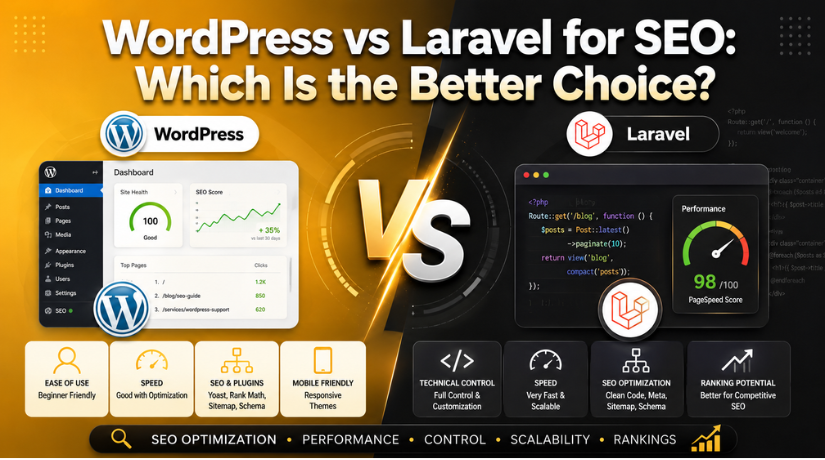
WordPress vs Laravel for SEO: Which Is the Better Choice?
Last updated on August 4th, 2026 at 05:37 am
You are choosing a platform for a new site. You care about search rankings. So which wins, WordPress vs Laravel for SEO?
The short answer: both can rank well, but they get there in very different ways. This guide breaks down the real differences, so you can pick with confidence.
The Quick Answer
Here is the difference in one line each:
- WordPress gives you SEO tools out of the box.
- Laravel gives you full control, but you build the SEO yourself.
WordPress is a content management system. Laravel is a PHP framework for building custom web apps. That single fact shapes the whole comparison.
If you are still unsure what category each tool fits, our guide on whether WordPress is a framework or a CMS is a helpful primer.
What Each Platform Actually Is
WordPress in Plain Terms
WordPress is ready-made software for publishing content. You install it, pick a theme, and start writing. It powers more than 40% of all websites in 2026, so the tooling around it is mature.
SEO features come through plugins. You add one plugin and get meta titles, sitemaps, and schema markup. No code needed.
Laravel in Plain Terms
Laravel is a toolkit for developers. It does not publish content on its own. You use it to build a custom application from scratch.
That means no built-in blog, no theme store, and no SEO plugins. You or your developer must code every SEO feature by hand.
Both tools run on PHP. If you are curious about the language behind them, you can even check your own site’s PHP version in a few clicks.
WordPress vs Laravel for SEO: The Core Difference
SEO has two sides. There is the content side, like titles, tags, and blog posts. There is the technical side, like speed, structured data, and clean URLs.
WordPress handles both sides for you. Laravel gives you a blank canvas for both. Neither approach is wrong. They just suit different projects.
So the real question is not which platform ranks higher. It is which platform matches your team and your goals.
In short, the WordPress vs Laravel for SEO decision is really a choice about how much you want to build yourself.
On-Page SEO: Content and Metadata
How WordPress Handles It
WordPress makes on-page SEO simple. A plugin like Yoast SEO or Rank Math adds a box under each post. You type your title, meta description, and focus keyword there.
The plugin then checks your work and flags problems. Our complete tutorial on the Yoast SEO plugin walks through the whole setup.
You get sitemaps, breadcrumbs, and social tags automatically. This is a big time saver for content-heavy sites.
How Laravel Handles It
Laravel has no SEO box. You build meta tags into your templates using Blade, its templating engine. You write logic to set a title and description for each page.
This gives you total control. You decide exactly what appears in the code. But it also takes developer time for every field.
For a large content site, that work adds up fast. For a small app with few pages, it is manageable.
Technical SEO: Speed, Structure, and Crawling
Search engines reward fast, clean sites. This is where the two platforms feel very different.
Speed and Core Web Vitals
Laravel apps can be extremely fast. There is no plugin bloat, and you load only the code you write. A well-built Laravel site often has lean, quick pages by default.
WordPress can be just as fast, but it needs care. Too many plugins slow it down. Good hosting, caching, and clean code keep it quick.
If speed is your worry, our guide on improving Core Web Vitals in WordPress shows what to focus on.


Structured Data and Schema
Schema markup helps search engines understand your pages. WordPress plugins add common schema types automatically.
In Laravel, you write the schema yourself. This is powerful for custom needs, like a booking app or a product catalog. But it is manual work.
Mobile and Indexing
Google indexes the mobile version of your site first. Most WordPress themes are mobile-ready out of the box. Plugins can also test and fix mobile issues.
Laravel sites can be fully mobile-friendly too. But you build that responsive design yourself. Nothing is automatic here. Both can pass Google’s mobile checks with the right work.
URLs and Crawlability
Both platforms produce clean URLs. WordPress does it through a setting. Laravel does it through your route definitions.
Both let you control redirects, canonical tags, and robots rules. Again, WordPress uses plugins, and Laravel uses code.
When WordPress Is the Better SEO Choice
WordPress usually wins for content-first projects. Pick it when:
- You publish blogs, guides, or news often.
- You want to manage SEO without a developer.
- You need to launch quickly and cheaply.
- Your team is non-technical.
- You want a huge library of themes and plugins.
Most small businesses and bloggers fit this list. For them, WordPress is the faster path to rankings.
When Laravel Is the Better SEO Choice
Laravel usually wins for custom applications. Pick it when:
- You are building a web app, not a blog.
- You need complex, custom features.
- You have developers on the team.
- You want full control over every line of code.
- Performance at large scale is critical.
Think of dashboards, marketplaces, or software tools. These often need Laravel’s flexibility, and their SEO can be built to match.
Can You Use Both Together?
Yes, and many teams do. This is called a headless or hybrid setup.
In this model, Laravel powers the custom app or backend. WordPress runs the blog and marketing pages. You get Laravel’s control and WordPress’s easy content SEO.
It is more complex to build and maintain. But for large brands, it offers the best of both worlds.
Common Myths to Avoid
- “Laravel ranks higher than WordPress.” False. Rankings come from content, links, and technical health, not the framework name.
- “WordPress is bad for SEO.” False. It powers a huge share of top-ranking sites.
- “Laravel needs no SEO work.” False. It needs more manual SEO work, not less.
- “You must pick one forever.” False. Sites can migrate or combine both over time.
For a related platform debate, see our comparison of WordPress vs a custom HTML website.
A Simple Way to Decide
Ask yourself two questions.
First, is this a content site or a custom app? Content sites lean WordPress. Custom apps lean Laravel.
Second, do you have developers? If not, WordPress is the safer bet. Its SEO tools do not need code.
If you still want to understand where WordPress sits among build tools, our post on whether WordPress is a platform or a framework adds useful context.
Getting SEO Help on WordPress
SEO takes ongoing work, whichever platform you choose. Plugins conflict. Speed scores drop. Schema breaks after updates.
You do not have to fix every issue alone. Our team at 24×7 WP Support handles WordPress SEO setup, speed tuning, and technical fixes around the clock. That lets you focus on your content and your business.
Final Thoughts
So, WordPress vs Laravel for SEO — which is the better choice? It depends on what you are building.
Choose WordPress for content sites that need fast, code-free SEO. Choose Laravel for custom apps where developers control everything. And remember, you can blend the two when a project calls for it.
There is no single winner here. There is only the right fit for your goals. Pick the platform that matches your team, and the rankings will follow the work you put in.
Related posts:
Does WordPress Use MySQL or PostgreSQL? A 2026 Explainer
WordPress Version History: The Release Timeline from 4.0 to 6.5.2
WordPress featured image not showing – The Probable Reasons and How to Resolve this Issue?
How to Integrate BigCommerce with WordPress?
How Much Maintenance Does a WordPress Site Need in 2026?

Brian is a WordPress support specialist and content contributor at 24×7 WP Support. He writes practical, easy-to-follow guides on WordPress troubleshooting, WooCommerce issues, plugin and theme errors, website security, migrations, performance optimization, and integrations. With a focus on solving real website problems, Brian helps business owners, bloggers, and online store managers keep their WordPress sites running smoothly.