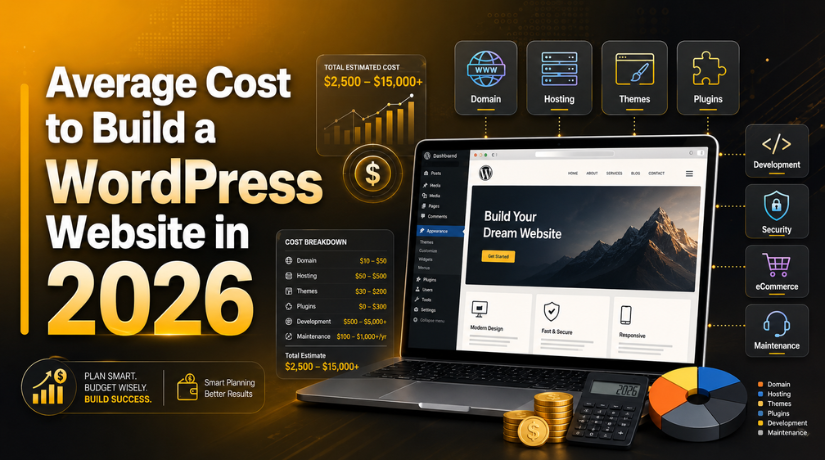
Average Cost to Build a WordPress Website in 2026
Introduction
One of the first questions every business owner, blogger, or entrepreneur asks is simple but frustratingly hard to answer: how much does a WordPress website actually cost? You’ll find figures ranging from a few hundred dollars to well over $100,000, and both can be accurate — it just depends on what you’re building, who’s building it, and what you need it to do.
In 2026, WordPress still powers over 43% of all websites on the internet, and the cost to get one up and running has never been more flexible. But that flexibility is exactly what makes budgeting confusing. This guide breaks down every cost component — from domain registration to custom development — so you can walk away with a realistic number for your specific project.
The Real Cost Range: What to Expect in 2026
Before diving into the details, here’s a realistic snapshot of what different WordPress websites actually cost in 2026:
- DIY personal blog or hobby site: $50 – $300 per year
- Small business website (DIY or template): $300 – $1,500 per year
- Professional small business website (freelancer-built): $1,500 – $8,000 one-time build cost
- Mid-size business or eCommerce site: $5,000 – $20,000+
- Custom enterprise WordPress build: $25,000 – $100,000+
The most common real-world scenario for a small business — a clean, professional website built by a freelancer or small agency — lands somewhere between $3,000 and $10,000 for the initial build, plus $500 to $2,000 per year in ongoing costs. Keep that number in mind as we break down each piece.
Domain Name: Your First Cost
Your domain name is your address on the web, and it’s typically your cheapest cost. A standard .com domain runs $10 to $20 per year through registrars like Namecheap, GoDaddy, or Google Domains. Newer extensions (.io, .co, .agency) can run $25 to $50 per year. Premium or previously owned domains can cost hundreds to thousands of dollars if someone else is selling one you want.
The practical advice: stick with a clean, memorable .com if you can get it. Budget $15/year and move on — don’t let domain obsession slow your launch.
WordPress Hosting: Biggest Variable in Your Annual Budget
Hosting is where budgets diverge dramatically. WordPress.org (the self-hosted version) is free — but you need a server to run it on, and that’s what you’re paying for when you buy hosting.
Shared Hosting
Entry-level shared hosting plans from providers like Bluehost, SiteGround, or Hostinger start at $3 to $10 per month (often on promotional pricing). This works for low-traffic blogs and simple brochure sites, but performance suffers as traffic grows. Renewal rates after the first year often jump to $15–$25/month, so factor that in.
Managed WordPress Hosting
Managed hosting providers like WP Engine, Kinsta, or Flywheel handle server maintenance, security patches, automatic backups, and performance optimization for you. Plans start around $20/month and can run $100+/month for higher-traffic sites. For a business website where downtime costs money, managed hosting is usually worth it. You can read our full breakdown of WordPress hosting costs in 2026 to compare providers in detail.
VPS and Dedicated Hosting
VPS (Virtual Private Server) hosting gives you dedicated resources at $20–$80/month. Dedicated servers — used by high-traffic enterprise sites — start at $100/month and can run several hundred per month. Unless you’re running a large media site or complex web application, most businesses don’t need this.
Hosting budget summary: Budget $10–$30/month for most small businesses, $30–$100/month if you want managed hosting with full support.
WordPress Theme: Free vs. Premium
WordPress themes control the visual design of your site. There are thousands of free themes in the official WordPress.org directory — many of them excellent starting points for blogs and simple sites.
Premium themes from marketplaces like ThemeForest or direct theme developers (like Divi, Astra, or GeneratePress) typically cost $30 to $100 as a one-time purchase, or $50–$200/year for access to a theme builder and all templates. These premium options offer more customization, better support, and more regular updates.
If you’re hiring a developer, they may build a custom theme entirely from scratch — which is part of their development fee rather than a separate theme cost.
Theme budget: Free to $200. Most small businesses do well with a $50–$70 premium theme.
Plugins: The Features That Power Your Site
WordPress plugins add functionality — contact forms, SEO tools, backup systems, security, caching, eCommerce, membership systems, and hundreds of other features. There are over 60,000 free plugins in the WordPress repository, and many are high quality.
However, the essential plugins most business sites need will have premium versions that cost money:
- SEO plugin (Yoast Premium, RankMath Pro): $79–$99/year
- Security plugin (Wordfence Premium, Solid Security): $99–$119/year
- Backup plugin (UpdraftPlus Premium, BlogVault): $70–$149/year
- Forms plugin (Gravity Forms, WPForms Pro): $49–$199/year
- Caching/performance plugin (WP Rocket): $59/year
- eCommerce (WooCommerce core is free, but premium extensions add $50–$300+ per extension)
A typical small business site with the right plugin stack will spend $200–$500 per year on plugin licenses. eCommerce stores can easily spend $500–$1,500 on plugins and extensions.
Development Costs: DIY, Freelancer, or Agency?
This is the biggest variable in your total budget and the decision most people agonize over longest.
DIY (Do It Yourself)
If you’re comfortable with technology and have time to invest, you can build a WordPress website yourself. With a premium theme and page builder (like Elementor or Divi), you can create a professional-looking site without writing code. Your cost here is just your time plus hosting, theme, and plugins — potentially $200–$500 total for year one.


The hidden cost of DIY is time. Building a quality site yourself typically takes 40–100 hours for someone without prior experience. Decide honestly whether your time is better spent on your actual business.
Freelancer
Hiring a freelance WordPress developer or designer gives you professional results at a middle-tier cost. Freelancers in 2026 typically charge $50–$150 per hour or quote $1,500–$8,000 for a complete small business website project. You can find good freelancers on Upwork, Toptal, or through referrals.
Be clear about scope before you sign anything. A $2,000 quote can become $4,000 if requirements creep. Our guide to hiring someone to build a WordPress website covers what to ask and what to expect.
Web Design Agency
Agencies bring full teams — project managers, designers, developers, QA testers — which means higher quality, accountability, and capacity, but also higher prices. A small business website from a reputable agency typically costs $10,000–$35,000. Enterprise builds with custom integrations, advanced eCommerce, or complex functionality can push past $100,000.
Agencies make the most sense when you’re building something complex, you need a long-term partner for ongoing work, or the risk of a failed website launch has serious business consequences.
Hidden Costs Most People Don’t Budget For
This is where a lot of first-time website owners get surprised. Beyond the obvious costs above, here are the budget items that commonly catch people off guard:
Content Creation
Someone has to write your website copy — service pages, about page, product descriptions, blog posts. Professional copywriting costs $80–$300 per page. Photography (professional headshots, product photos) can run $500–$2,000 for a shoot. Stock photo subscriptions (Adobe Stock, Shutterstock) cost $30–$60/month.
Professional Email
Using a @gmail.com address for business looks unprofessional. Google Workspace (formerly G Suite) gives you a professional email at your domain for $6–$12/user/month. Budget $72–$144/year per email address.
SSL Certificate
A security certificate (the padlock in your browser) is essential for any website in 2026. Most modern hosts include a free SSL via Let’s Encrypt, but some charge $50–$100/year for premium certificates. Check with your host before paying for one separately.
Premium Support and Maintenance
WordPress core, themes, and plugins all release updates regularly. If you’re not handling updates yourself, you’ll want someone to. WordPress maintenance services typically cost $50–$300/month depending on how comprehensive the service is. We have a full breakdown of WordPress website maintenance costs that’s worth reviewing before you launch.
eCommerce: When WooCommerce Raises the Budget
Adding a store to your WordPress site significantly increases the cost and complexity. WooCommerce itself is free, but running an actual store adds:
- Payment gateway: Stripe and PayPal are free to set up but charge 2.9% + $0.30 per transaction
- WooCommerce extensions: Subscriptions, product bundles, advanced shipping, memberships — each premium extension costs $79–$299/year
- Better hosting: eCommerce needs faster, more reliable servers — budget $30–$100/month
- Security: Handling payments means stricter security requirements — budget $150–$300/year on security tools
A basic WooCommerce store built by a freelancer typically costs $3,000–$8,000 to launch. A custom eCommerce build by an agency can easily reach $20,000–$50,000 for complex inventory systems, custom checkout flows, or multi-currency support.
How to Reduce Your WordPress Website Cost Without Cutting Corners
You don’t have to break the bank to get a great WordPress website. Here are the smartest ways to save:
- Use a quality premium theme instead of paying for a fully custom design. Many premium themes look excellent out of the box.
- Write your own copy if you’re a confident writer. Or at minimum, provide detailed notes to a copywriter to reduce their time.
- Start with managed hosting from day one — you’ll avoid performance problems and emergency support costs later.
- Use a free security plugin like Wordfence’s free tier and a free backup tool like UpdraftPlus while you’re small, upgrading to premium only when the site generates revenue.
- Hire a freelancer for the build, then learn basic WordPress yourself for day-to-day content updates — this saves $100–$300/month in ongoing support costs.
What a Realistic Budget Looks Like by Site Type
To make this concrete, here are three realistic budget scenarios for 2026:
Personal Blog or Portfolio (DIY)
Domain ($15) + shared hosting ($60/year) + free theme + free plugins = $75–$200/year total
Small Business Website (Freelancer-Built)
Domain ($15) + managed hosting ($360/year) + premium theme ($70) + essential plugins ($300/year) + freelancer build ($4,000 one-time) = $4,745 year one, $750/year ongoing
Mid-Size eCommerce Store (Agency-Built)
Domain ($15) + managed hosting ($1,200/year) + WooCommerce extensions ($500/year) + security stack ($300/year) + agency build ($20,000 one-time) = $22,000+ year one, $2,000+/year ongoing
Get Expert Help With Your WordPress Site
Understanding the costs is one thing — actually building a fast, secure, well-optimized WordPress website is another. Whether you need help planning your budget, finding the right hosting, setting up WooCommerce, or troubleshooting an existing site, the team at 24×7 WP Support is here around the clock. We specialize in WordPress websites of all sizes and budgets, from simple business sites to complex custom builds. Reach out today and let us help you build something great — without overpaying for it.

Brian is a WordPress support specialist and content contributor at 24×7 WP Support. He writes practical, easy-to-follow guides on WordPress troubleshooting, WooCommerce issues, plugin and theme errors, website security, migrations, performance optimization, and integrations. With a focus on solving real website problems, Brian helps business owners, bloggers, and online store managers keep their WordPress sites running smoothly.