
WordPress Freelancer & Designer Pricing: Hourly Rates & Project Costs in 2026
Introduction
If you’re planning to build or redesign a WordPress website this year, one of your first questions is probably: how much is this going to cost me? The honest answer is that WordPress freelancer and designer pricing in 2026 varies widely — from $15/hour for an entry-level contractor overseas to $200+/hour for a seasoned North American expert. That’s a massive range, and without a clear understanding of what drives those numbers, it’s easy to overpay for basic work or underpay and end up with a site that needs to be rebuilt in six months.
This guide breaks down what WordPress freelancers and designers actually charge in 2026, what separates a designer from a developer, and how to figure out which type of professional you really need for your project.
WordPress Designer vs. WordPress Developer: Know the Difference First
Before you budget anything, you need to understand who you’re hiring. These two roles are often confused — and they command very different rates.
A WordPress designer focuses on the visual side of your website: layouts, typography, colour palettes, branding, and user experience. They work primarily with page builders like Elementor or Divi, customise themes, and make sure your site looks polished and professional. Most designers work without touching a line of PHP or JavaScript.
A WordPress developer handles the technical side: custom theme development, plugin creation, database integration, REST API connections, performance optimisation, and WooCommerce builds. Their work lives in the code editor, not the visual builder.
Many freelancers combine both skill sets to some degree, but specialists exist at both ends. For a standard business website with a quality premium theme, a designer is usually sufficient. For a custom platform, complex e-commerce store, or anything requiring bespoke functionality, you’ll need a developer — and the rates reflect that.
If you’re unsure how much a full WordPress website build costs beyond just the freelancer fees, our breakdown of how much it costs to build a WordPress website in 2026 covers all the layers, including hosting, themes, and plugins.
WordPress Freelancer Hourly Rates in 2026
Hourly pricing is the most common billing model for ongoing work, smaller projects, and retainer-based relationships. Here’s what the market looks like in 2026 across experience tiers.
Entry-Level (0–2 years experience)
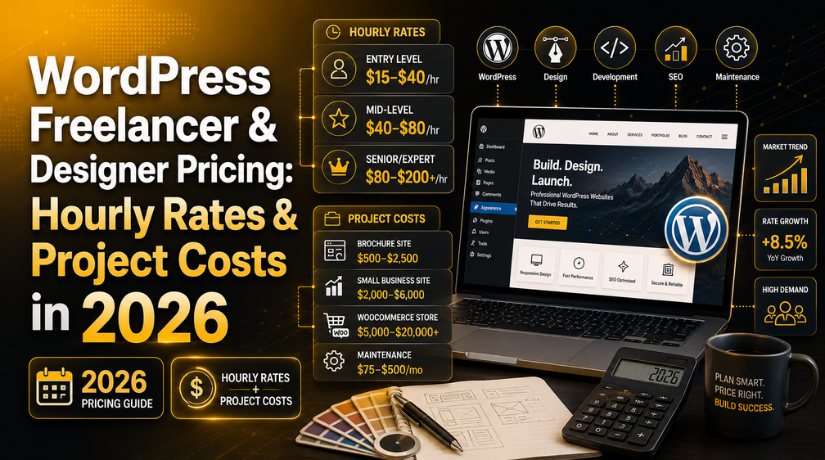
Entry-level freelancers typically charge between $15 and $40 per hour. These are individuals who know their way around WordPress, can install and configure themes and plugins, and handle basic site setups. They’re a solid choice for simple content sites or landing pages where design requirements are minimal and no custom code is needed. Expect to invest more time in briefing and reviewing their work.
Mid-Level (2–5 years experience)
Mid-level professionals are the sweet spot for most small to medium business projects. Rates fall between $40 and $80 per hour, with the average sitting around $55–$65/hour in North America. At this tier, freelancers bring genuine design sensibility or solid development ability, can manage a project independently, and have the portfolio to back up their claims. This is where you find reliable designers who can build a conversion-focused site from a premium theme and reliable developers who can customise without breaking things.
Senior/Expert (5+ years experience)
Senior WordPress professionals — specialists in headless WordPress, WooCommerce at scale, or high-performance enterprise sites — charge anywhere from $80 to $200+ per hour. North American senior developers average around $100–$128/hour. If your project demands precise technical execution, custom plugin development, or integration with third-party APIs, the premium is worth it. Higher hourly rates from experienced developers also mean faster delivery, fewer bugs, and less back-and-forth.
Geographic Pricing Differences
Where your freelancer is based significantly affects what you’ll pay — sometimes by 50–60%. Here’s a general breakdown for 2026:
United States & Canada: $50–$200/hour depending on skill level. Premium rates, but also the easiest communication, time zone alignment, and contractual protection if you’re US-based.
Western Europe (UK, Germany, Netherlands): $40–$120/hour. Strong technical talent, particularly for WooCommerce and multilingual WordPress projects.
Eastern Europe (Poland, Ukraine, Romania): $25–$60/hour. North American senior WordPress developers bill 43% more on average than their Eastern European counterparts of similar skill. Eastern European developers consistently punch above their price point.
South/Southeast Asia (India, Philippines, Pakistan): $15–$35/hour. The widest quality range exists here. You can find genuinely skilled developers in this tier, but vetting matters enormously — spend time on portfolio reviews and paid test tasks before committing to a larger project.
One important 2026 market trend worth noting: the demand for low-complexity template work is increasingly absorbed by AI-assisted tools and $20–$25/hour contractors, while engineering-grade work (scalable WooCommerce, custom Gutenberg blocks, headless architectures) continues to command strong rates regardless of geography.
Project-Based Pricing: What to Expect for Common WordPress Projects
Hourly rates matter, but most clients think in terms of total project cost. Here are realistic ranges for common WordPress projects in 2026.
Simple Brochure Website (1–5 pages)
A basic informational site — home, about, services, contact — built on a premium theme with standard customisation runs $500 to $2,500 with a freelancer. Agencies will charge more. At the lower end, you’re getting template-driven work with minimal custom touches. At the upper end, you’re getting thoughtful layout design, brand integration, and mobile optimisation.


Small Business Website (5–15 pages)
The most common project type. Budget $2,000 to $6,000 for a professionally designed small business site. This includes a custom-configured premium theme, branded styling, contact forms, basic SEO setup, and a few rounds of revisions. If you want a blog, team page, testimonials section, or service pages with individual layouts, expect to sit in the $3,500–$5,500 range.
WooCommerce / E-commerce Store
E-commerce work starts at $5,000 and runs well past $20,000 for anything complex. A simple store (under 50 products, standard payment gateway, no custom pricing rules) might come in at $4,000–$8,000. A store with variable products, custom checkout logic, shipping integrations, or a subscription model will push $12,000–$25,000. At the high end of custom WooCommerce builds, you’re essentially doing custom software development.
Custom Theme or Plugin Development
Fully custom theme builds — designed from scratch in code rather than a page builder — start around $5,000 and regularly exceed $15,000. Custom plugin development varies enormously based on complexity: a simple plugin to add functionality can be $500–$1,500, while a complex membership or booking plugin runs $5,000–$20,000+.
Before committing to a custom build, it’s always worth evaluating whether a well-configured premium theme and the right plugin stack can meet your needs. Check out our guide on how much it costs to hire someone to build a WordPress website for a fuller picture of agency versus freelancer trade-offs.
Ongoing Maintenance and Retainer Costs
A one-time build cost is only part of the picture. Most WordPress sites need ongoing maintenance — updates, backups, security monitoring, content changes, and periodic performance tuning.
Basic maintenance plans from freelancers in 2026 typically run $75 to $150/month. These cover plugin and core updates, uptime monitoring, and regular backups. More comprehensive plans that include security scanning, minor content edits, and priority response time range from $150 to $500/month.
If you need a developer on retainer for ongoing feature development or changes, budget $1,000 to $3,000/month for a mid-to-senior level freelancer at a set number of hours per month. Agencies offering retainer packages typically start at $1,500–$2,500/month for comparable service.
Keeping your WordPress site properly maintained also protects your investment from security threats. If you haven’t reviewed your site’s security posture recently, our complete WordPress security guide is a practical starting point.
Freelancer vs. Agency: Where Should You Spend Your Budget?
Freelancers generally charge 20–40% less than agencies for comparable skill levels, because they don’t carry agency overhead. For most small business websites, a vetted mid-level freelancer delivers equivalent quality at a meaningfully lower price. The trade-off is that you’re relying on one person: if they get sick, take another project, or disappear after launch, you have no backup.
Agencies offer continuity, broader skill sets (designer, developer, and project manager in one team), and formal contracts. For larger, multi-phase projects — especially anything over $15,000 — the structure of an agency engagement often justifies the premium.
The right answer depends on your project size and risk tolerance. For a $3,000 business site, a reliable freelancer is usually the smarter choice. For a $30,000 WooCommerce platform, the oversight and accountability of an agency matters more.
Red Flags to Watch For When Hiring
Pricing is only half the hiring decision. Here are a few patterns that should give you pause regardless of rate:
Vague proposals with no itemised scope are a warning sign — if a freelancer can’t break down what they’ll actually deliver, you can’t hold them accountable when deliverables drift. Unusually low quotes ($300 for a “complete business website”) almost always mean a template being installed with minimal customisation, no real design thinking, and work you’ll want to redo within a year. On the other end, never pay more than 30–40% upfront without a clear milestone schedule. And check whether the freelancer uses child themes — a developer who works directly in the parent theme will leave you unable to update WordPress without losing your customisations.
How to Get Accurate Quotes
The more clearly you define your project, the more accurate your quotes will be — and the better you can compare proposals apples to apples. Before reaching out to freelancers, prepare a project brief that includes: the number of pages and types (service pages, landing pages, blog), your design preferences or reference sites, whether you have branding assets (logo, colours, fonts), your target launch date, and any specific functionality you need (forms, bookings, e-commerce, membership).
Request a minimum of three quotes for any project over $2,000. Ask each candidate to break down how they’ve allocated their estimate — design, development, revisions, testing, and launch support should all be accounted for separately.
Get Expert WordPress Help Without the Hiring Headache
Finding a trustworthy WordPress freelancer takes time — screening portfolios, evaluating proposals, managing communication across time zones. If you’d rather skip that process and work directly with a team that knows WordPress inside and out, 24×7 WP Support handles everything from site builds and redesigns to ongoing maintenance and emergency fixes. Our team is available around the clock, so your site gets the attention it needs when it needs it — not when your freelancer’s schedule opens up. Browse our blog for more WordPress guides, or reach out today to discuss what your project actually needs.
Related posts:
Ghost vs WordPress: Which Platform Is Better for Your Website?
How to Add Klaviyo Forms and Popups to WordPress Easily (Detailed Guide)
Do WordPress Blogs Make Money? How to Monetize Your Blog in 2026
Sure Shot Way to Fix 405 Method Not Allowed Error
Can You Create a WordPress Website for Free? Free vs Paid Options

Brian is a WordPress support specialist and content contributor at 24×7 WP Support. He writes practical, easy-to-follow guides on WordPress troubleshooting, WooCommerce issues, plugin and theme errors, website security, migrations, performance optimization, and integrations. With a focus on solving real website problems, Brian helps business owners, bloggers, and online store managers keep their WordPress sites running smoothly.