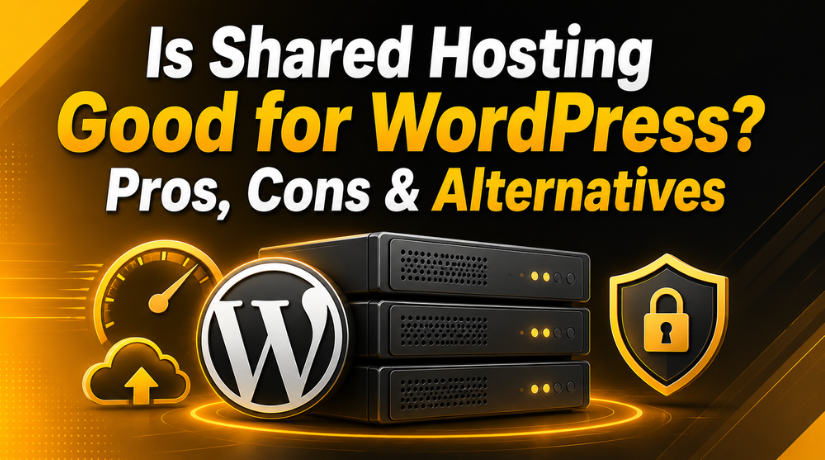
Is Shared Hosting Good for WordPress? Pros, Cons & Alternatives
Introduction
If you’re just starting a WordPress site in 2026, one of the first decisions you’ll face is picking a hosting plan. Shared hosting is usually the cheapest option on the list — and that price tag is tempting. But is it actually a smart choice for WordPress, or will it hold your site back?
The honest answer is: it depends. Shared hosting can work perfectly well for the right type of WordPress site. For others, it becomes a source of constant frustration. In this guide we’ll break down exactly what shared hosting is, where it shines, where it falls short, and what your alternatives look like — so you can make a decision with full information.
What Is Shared Hosting, Exactly?
Shared hosting means your website lives on a physical server alongside hundreds or even thousands of other websites. You all split the same pool of CPU, RAM, disk I/O, and bandwidth. The hosting company manages the server entirely — you just get a control panel (usually cPanel or Plesk) to manage your files, databases, and email.
Because the hardware costs are divided among so many customers, shared plans are extremely affordable. You can find reputable shared hosting for $3–$8 per month. For someone launching a first blog or a small business website, that cost barrier is basically nonexistent.
The tradeoff is that you have no control over the server environment, no dedicated resources, and your site’s performance can be influenced by what other tenants on that server are doing at any given moment.
Where Shared Hosting Works Well for WordPress
New Blogs and Small Business Websites
If you’re launching a personal blog, a portfolio, or a local business brochure site that expects fewer than 5,000–10,000 monthly visitors, shared hosting is genuinely fine. WordPress itself doesn’t require heavy resources when you’re running a well-optimized site with a lightweight theme, a caching plugin, and a modest number of posts.
Many seasoned WordPress developers started their first projects on shared hosting and ran them successfully for years before needing to upgrade. The technology has improved significantly — providers like SiteGround, A2 Hosting, and Hostinger now run shared environments on SSDs with HTTP/2 and server-level caching, which means even entry-level plans deliver decent speed for lightweight sites.
Tight Budgets and Early Experiments
Sometimes you’re not sure whether a project will gain traction. Starting on shared hosting lets you validate your idea without spending $30–$100/month on a VPS or managed hosting plan before you even have an audience. If the site takes off, you upgrade. If it doesn’t, you haven’t lost much.
Non-Technical Users Who Want Everything Managed
Shared hosting comes with a lot bundled in: email accounts, basic backups, a one-click WordPress installer, SSL certificates, and customer support. For a small nonprofit, a local restaurant, or a freelancer with limited technical knowledge, this all-in-one setup is a legitimate advantage. You don’t need to configure anything yourself.
The Real Problems with Shared Hosting for WordPress
The Noisy Neighbor Effect
This is the most well-known downside of shared hosting — and it’s very real. Since all sites on a server share the same resources, a neighbor running a resource-heavy WooCommerce store or getting hit by a bot traffic wave can eat up CPU and RAM, causing your completely unrelated site to slow to a crawl or return timeout errors. You have no visibility into this, and no direct way to fix it.
Modern shared hosting providers have gotten better at limiting this with technologies like CloudLinux’s LVE (Lightweight Virtual Environment), which creates hard resource ceilings per account. But even with these guardrails, the underlying problem doesn’t disappear entirely — it just gets capped at a lower severity.
Resource Caps That Are Easily Hit
Shared plans cap your CPU usage, RAM allocation, simultaneous connections, and sometimes even the number of PHP workers. For a simple blog this is invisible. But once you start adding WooCommerce, a page builder with 15 plugins, a membership system, or a learning management system, you’ll start bumping into these limits. The result is slow admin areas, occasional 503 errors, and a hosting support ticket that tells you to upgrade.
Limited PHP and Server Configuration Control
Running WordPress well sometimes means tweaking PHP settings — increasing memory limits, adjusting max execution time, enabling specific PHP extensions, or running a particular PHP version. On shared hosting you can often make basic adjustments via a .htaccess file or a PHP options panel, but you’re constrained by what the hosting company allows globally for all accounts on the server. On a VPS, you set it however you need.
Security Is Shared Too
If another site on your shared server gets hacked — a surprisingly common event — there’s a risk that the compromise could affect neighbouring accounts. This is less common than it used to be thanks to better account isolation, but it hasn’t been eliminated. For a business handling customer data or running transactions, this shared attack surface is a legitimate concern.
Scaling Is an On/Off Switch, Not a Dial
With shared hosting, you can’t gradually add resources as traffic grows. You’re on a fixed plan. When you outgrow it, the solution is to move to an entirely different hosting type — which means migrating your site. That’s not the end of the world, but it does take planning and downtime risk. VPS and cloud hosting let you scale resources incrementally without migrating.
Shared Hosting vs. WordPress-Specific Hosting
Some providers market “WordPress hosting” as a distinct product. In many cases, this is simply shared hosting with WordPress pre-installed and a few WordPress-focused features added: automatic core updates, WordPress-specific caching, and a support team trained on WordPress issues.
If you’re buying from a quality provider, WordPress hosting on shared infrastructure performs better for WordPress specifically than generic shared hosting — the environment is tuned for it. But it’s still shared, so the fundamental resource limitations apply.
True managed WordPress hosting (like Kinsta, WP Engine, or Cloudways) is a completely different product. It typically runs on VPS or cloud infrastructure with dedicated resources, automatic backups, staging environments, and hands-off management. It costs significantly more but removes most of the pain points described above. If you want to explore more hosting options for your setup, our detailed guide on the top 20 web hosting service providers covers a wide range of options across price points.
When You Should Move Away from Shared Hosting
Signs It’s Time to Upgrade


There are clear signals that your WordPress site has outgrown shared hosting. Pay attention to these:
- Page load times consistently above 3 seconds despite using a caching plugin and image optimization
- Frequent 503 or 508 errors (resource limit exceeded) during traffic spikes
- Your host’s support team repeatedly suggesting an upgrade when you report slowness
- Traffic growing past 10,000–15,000 monthly visitors and you’re selling products or running ads
- Running WooCommerce with real transaction volume — slow checkout pages kill conversions
- Security incidents or unexplained downtime you can’t trace back to your own site
If two or more of these apply, you’ve outgrown shared hosting. The good news is that upgrading to a VPS or cloud hosting plan is usually less complicated than it sounds, and the performance difference is immediately noticeable.
The Alternatives Worth Considering in 2026
VPS Hosting
A Virtual Private Server gives you a dedicated slice of a physical server — guaranteed CPU and RAM that no neighbour can touch. You get root access, can install custom software, and have full control over your PHP configuration. The tradeoff is that you’re responsible for server management (unless you choose a managed VPS where the host handles updates and security). VPS plans from providers like Vultr, Linode, or DigitalOcean start around $6–$12/month for basic configurations, which is surprisingly affordable.
Managed WordPress Hosting
This is shared hosting’s opposite in almost every way. Managed WordPress hosting (WP Engine, Kinsta, Cloudways, Flywheel) provides enterprise-grade infrastructure, automatic backups, staging environments, and a support team that lives and breathes WordPress. Pricing starts around $25–$35/month and goes up from there. For a business where the website directly generates revenue, this is usually money well spent.
If you’re curious about one of the faster managed options, our hands-on guide to using EasyWP for fast WordPress hosting walks through exactly what to expect from a managed environment built for performance.
Cloud Hosting
Cloud hosting distributes your site across multiple servers, meaning if one node goes down your site stays up. It also makes scaling trivially easy — you add resources with a few clicks and pay only for what you use. It’s the right choice for high-traffic sites, media companies, or businesses with unpredictable traffic patterns. Google Cloud, AWS, and Azure all offer WordPress-compatible setups, though the learning curve is steeper.
What About Free Hosting?
Free WordPress hosting exists, but it comes with significant limitations: ads placed on your site by the host, no custom domain, minimal support, and uncertain uptime. It’s useful for experiments or learning, but not for any site you care about. We’ve put together a detailed breakdown of free WordPress hosting options if you want to understand exactly what’s available and where each option draws the line.
How to Get the Most Out of Shared Hosting If You Stick With It
If shared hosting is right for your situation, there are practical things you can do to squeeze the best performance out of it.
Install a Caching Plugin
This is the single biggest performance lever available to you. A caching plugin like WP Rocket, LiteSpeed Cache (if your host supports it), or W3 Total Cache stores pre-built versions of your pages so WordPress doesn’t have to rebuild them from the database on every request. The reduction in server load is dramatic. Enable caching before you do anything else.
Keep Plugins to a Minimum
Every plugin adds overhead. Audit your installed plugins regularly and deactivate anything you’re not actively using. Prefer plugins with a proven performance record over feature-rich alternatives that bloat your site. This matters more on shared hosting than anywhere else because your resource budget is tighter.
Use a Lightweight Theme
Themes like GeneratePress, Astra, and Kadence are designed to be fast and lean. Avoid page builder-heavy themes bundled with dozens of features you’ll never use. A lightweight theme combined with a good caching plugin can make a shared hosting site feel significantly faster than its infrastructure should allow.
Optimize Images
Uncompressed images are one of the most common causes of slow WordPress sites. Use a plugin like Imagify, ShortPixel, or Smush to automatically compress images on upload. Serve images in modern formats (WebP) where your server supports it. This reduces both page weight and the I/O load on shared disk resources.
Pick the Right Host
Not all shared hosting is created equal. Providers with SSD storage, HTTP/2, PHP 8.x support, and built-in object caching (Redis or Memcached) will outperform budget hosts running decade-old infrastructure at the same price. Do your homework before committing. Some hosts that are heavily advertised are not the best performers — we’ve written candidly about why Bluehost isn’t always the right choice for WordPress despite its marketing reach, which may help you avoid a common mistake.
So, Is Shared Hosting Good for WordPress?
Yes — for the right site. If you’re running a blog, a small business website, a portfolio, or any WordPress project under around 10,000 monthly visitors, a quality shared hosting plan will serve you perfectly well in 2026. The key words are “quality” and “right site.” Cheap shared hosting from a provider that oversells its servers will frustrate you. And a growing WooCommerce store or a high-traffic content site will hit the wall quickly.
Shared hosting is a starting point, not a permanent solution for every WordPress site. Use it to get started, learn what your site actually needs, and be ready to upgrade when the signs appear. The upgrade path to VPS or managed WordPress hosting is well-established and worth it once your site is generating real value.
If you’re not sure whether your current hosting is holding your WordPress site back — or if you need help migrating to a better setup — the team at 24×7 WP Support is here to help. We handle WordPress hosting migrations, performance audits, and ongoing support so you can focus on running your site, not your server. Get in touch with us today and let’s find the right hosting solution for where your site is headed.


Brian is a WordPress support specialist and content contributor at 24×7 WP Support. He writes practical, easy-to-follow guides on WordPress troubleshooting, WooCommerce issues, plugin and theme errors, website security, migrations, performance optimization, and integrations. With a focus on solving real website problems, Brian helps business owners, bloggers, and online store managers keep their WordPress sites running smoothly.