Do People Still Use WordPress for Blogging in 2026? The Complete Answer
Introduction
If you’ve been asking yourself whether WordPress is still relevant for blogging in 2026, you’re not alone. With so many platforms competing for attention, it’s natural to wonder whether the world’s most popular CMS still deserves that title — especially for bloggers. The short answer is a resounding yes. But let’s go much deeper than that, because why people still choose WordPress for blogging tells a much more interesting story than any simple yes or no could capture.
WordPress Still Dominates the Blogging World in 2026
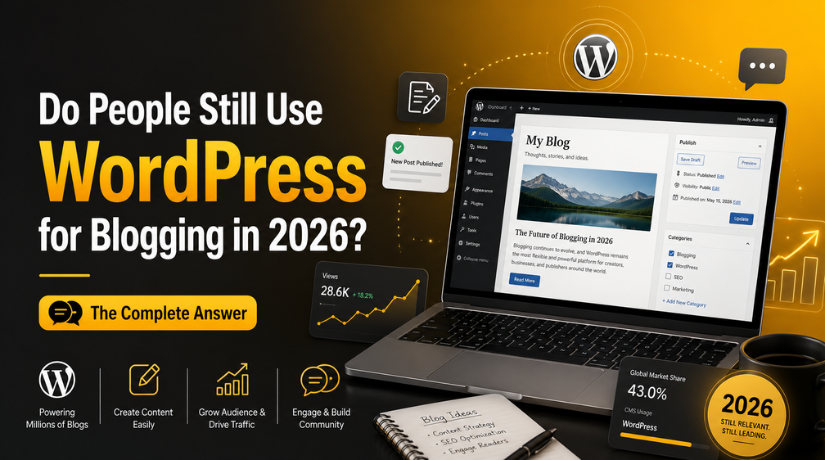
The numbers don’t lie. As of May 2026, WordPress powers approximately 43% of all websites on the internet — a figure that continues to grow year over year. Even more striking for bloggers specifically: WordPress is estimated to power nearly half of all blogs globally, both personal and professional.
Every single day, around 2.33 million blog posts are published through WordPress. That adds up to over 70 million posts every month. If WordPress were dying, those numbers would tell a very different story. Instead, they tell the story of a platform that has more active users today than at any previous point in its history.
What makes this dominance even more impressive is that WordPress has maintained — and expanded — this position in an era where dozens of slick, well-funded alternatives have tried to take its crown. Ghost, Squarespace, Wix, Webflow, Medium, Substack — all have made a play for bloggers’ attention, and yet WordPress keeps growing. Clearly, bloggers keep coming back for a reason. Several reasons, actually.
Why Bloggers Keep Choosing WordPress in 2026
It’s easy to assume people stick with WordPress out of habit or inertia. In reality, the reasons are far more deliberate and practical. Here’s what keeps bloggers loyal to the platform.
You Own Everything You Create
This is perhaps the single most important factor for serious bloggers in 2026. When you build your blog on WordPress — specifically WordPress.org, the self-hosted version — every word, image, and piece of data belongs entirely to you. You’re not renting space on someone else’s platform. You’re not subject to sudden policy changes that could delete your content, restrict your monetization, or sunset the service overnight.
Over the past few years, multiple popular blogging platforms have abruptly shut down, radically changed their monetization terms, or started restricting what creators can publish. Bloggers who built their audiences on self-hosted WordPress didn’t lose a thing. That kind of resilience has real value for anyone building a long-term content brand.
Unmatched SEO Control
Bloggers live and die by search traffic, and WordPress gives you more hands-on control over SEO than virtually any other platform available today. From custom permalink structures and meta tags to schema markup, canonical URLs, and site speed optimization, you can fine-tune every element that search engines care about.
Plugins like Yoast SEO and Rank Math make this even more accessible, walking you through on-page optimization with intuitive interfaces that don’t require a technical background. If growing organic traffic is part of your blogging strategy — and it absolutely should be — WordPress gives you the tools to do it properly. You can learn more about keeping your WordPress site healthy and high-performing in our guide on Best WordPress Security Plugins to Protect Your Site in 2026.
A Plugin Ecosystem That Solves Every Problem
Need a contact form? There’s a plugin. Want to add an email newsletter opt-in, a membership area, an affiliate link manager, an online course, or a podcast feed? There are plugins for all of it. WordPress has over 59,000 free plugins in its official directory alone, with thousands more available through third-party developers.
For bloggers, this means you can start simple and add powerful functionality as your blog grows — without ever needing to rebuild from scratch or migrate to a different platform. Your blog can evolve alongside your ambitions without hitting a ceiling.
Total Design Freedom
Whether you want a clean, minimal blog aesthetic or a bold, magazine-style layout packed with color and imagery, WordPress can deliver it. Thousands of free and premium themes are available, and with modern page builders like Elementor or the built-in block editor, you can customize your blog’s look without touching a single line of code. Our article on Best Free WordPress Themes: Where to Find and Download in 2026 covers some of the top picks for bloggers specifically.
An Enormous, Helpful Community
When you run into a problem with WordPress — and at some point, you will — you’re never alone. Millions of WordPress users, developers, and enthusiasts have been answering questions, writing tutorials, and building help resources for over two decades. Whatever issue you encounter, someone has already solved it and written about the solution in detail. No other blogging platform comes close to matching this level of community support and collective knowledge.
The Two Flavors of WordPress: .org vs .com Explained
One persistent source of confusion for new bloggers is the difference between WordPress.org and WordPress.com. They share a name and some underlying technology, but they work quite differently in practice.
WordPress.org is the free, open-source software you download and install on your own web hosting account. This is what most experienced bloggers mean when they say “WordPress.” You have full control, unlimited customization, and complete ownership of your content, design, and data.
WordPress.com is a hosted service built on the WordPress software. It manages the technical hosting side for you, but at the cost of flexibility. The free tier includes forced advertising on your blog, restricted plugin access, and a WordPress-branded subdomain rather than your own custom domain. Paid plans remove most of these restrictions, but comparable self-hosted setups generally offer more value.
For serious bloggers who plan to monetize their content, build an audience, or maintain long-term ownership of their platform, WordPress.org with your own web hosting is the clear choice. It gives you the full power of WordPress without the constraints.


Is WordPress Difficult to Use for Blogging?
This is the objection you’ll hear most often from people considering alternatives. And honestly, in 2026, it carries far less weight than it used to.
The WordPress block editor — known as Gutenberg — has matured significantly since its introduction. Writing a blog post today is genuinely intuitive. You click to add blocks, including paragraphs, images, headings, pull quotes, bulleted lists, and embeds, and the layout builds naturally as you write. Standard blogging tasks require no coding whatsoever.
Setup does require slightly more effort upfront than some fully hosted platforms, but it’s a one-time investment of an hour or two. Once your WordPress site is configured, the day-to-day experience of writing, editing, and publishing blog posts is smooth and efficient. And if you run into technical snags along the way, help is always available. Check out our guide on Why Can’t I Log Into My WordPress Site? 7 Common Fixes for solutions to one of the most common beginner issues.
Who Might Be Better Served by a Different Platform
A balanced answer requires acknowledging that WordPress isn’t the perfect fit for every single person. Here are a few scenarios where an alternative might genuinely serve you better.
You Want Absolutely Zero Technical Involvement
If managing hosting, running updates, handling backups, and troubleshooting plugin compatibility sounds like a nightmare rather than a manageable task, a fully managed hosted platform might suit you better. Platforms focused purely on the writing experience eliminate nearly all technical overhead. The trade-off is that you give up control, ownership protections, and long-term flexibility — but for some hobbyists, that’s an acceptable exchange.
Your Blog is Purely a Personal Hobby
If you’re writing purely for personal enjoyment with no intention of ever monetizing, growing an audience, or building a brand around your content, a simpler free platform could be perfectly adequate. The power and flexibility WordPress offers become less valuable when you genuinely don’t need them.
That said, many bloggers who started “just for fun” quickly found themselves wanting more control over their site as their passion grew. Starting on WordPress from the beginning means you never have to go through the painful process of migrating an established blog to a new platform later.
How WordPress Has Evolved to Stay at the Top
WordPress hasn’t maintained its dominance by standing still. The development team and the broader open-source community have continuously improved the platform to address common criticisms and keep pace with what modern bloggers need.
Full Site Editing capability now gives users visual control over their entire website — headers, footers, sidebars, page templates — without needing a separate third-party page builder. Core performance improvements have made WordPress sites faster by default, with better image handling, lazy loading, and code optimization baked in. Security hardening has been an ongoing priority, with automatic updates for minor releases helping keep sites protected against known vulnerabilities.
The result is a platform that combines the flexibility and ownership advantages it has always offered with a substantially better user experience than WordPress delivered five years ago. The criticisms that were fair in 2019 are considerably less valid in 2026.
WordPress for Blogging: The Definitive 2026 Verdict
Yes, people absolutely still use WordPress for blogging in 2026 — in enormous numbers, and for excellent reasons. The platform powers nearly half of all blogs on the internet, publishes over 70 million posts every single month, and has continued growing its market share even as well-funded competitors have tried their hardest to unseat it.
For bloggers who are serious about their work — who want to own their content, control their SEO, build an audience, and create something sustainable for the long term — WordPress delivers in ways that alternatives simply cannot match. The learning curve is real but entirely manageable, and the payoff in terms of flexibility, ownership, and long-term value is substantial.
The question isn’t really whether people still use WordPress for blogging in 2026. The better question is: why would anyone who is serious about blogging choose anything else?
Start or Strengthen Your WordPress Blog Today
Whether you’re setting up your very first WordPress blog or looking to get significantly more out of an existing one, the team at 24×7 WP Support is here to help every step of the way. From initial setup and configuration to ongoing troubleshooting, optimization, and expert guidance, we provide professional WordPress support around the clock — because your blog deserves to run at its best, all the time. Browse our full library of WordPress guides and tutorials, or reach out directly and let us handle the technical side while you focus entirely on creating great content. In 2026, WordPress remains the gold standard for serious bloggers — and we’re here to help you make the most of it.

Brian is a WordPress support specialist and content contributor at 24×7 WP Support. He writes practical, easy-to-follow guides on WordPress troubleshooting, WooCommerce issues, plugin and theme errors, website security, migrations, performance optimization, and integrations. With a focus on solving real website problems, Brian helps business owners, bloggers, and online store managers keep their WordPress sites running smoothly.